Main Range Circuit from Guthega

Download & Print Map and Notes

Tap again to allow map panning

Time 4 Days
Circuit 45 km Circuit
Climb 2317 m
Grade 5 Experienced only
Car
no_pets
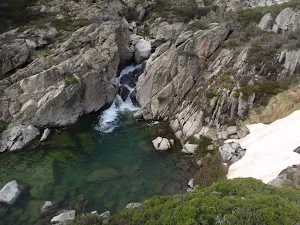
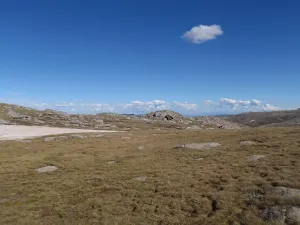
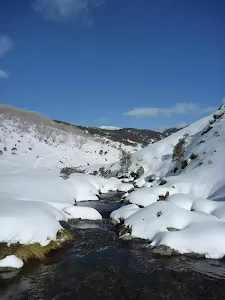
This four day walk explores the Kosciuszko National Park, covering many of the key features of the park between Guthega and Rawson Pass. Some of the more popular sights you will visit are the Snowy River, Blue Lake and Lake Albina, a couple of great alpine huts and the two highest peaks in Australia, Mt Townsend and Mt Kosciuszko. The water supply from the creek at the first nights campsite is unreliable, so consider filling up at the Snowy River on the way.

* This walk passes through very remote areas and sections have no visible track. At least one person in your group should have training and experience in off track walking and navigation. Even with these notes and a GPS these extra skills and equipment are required.

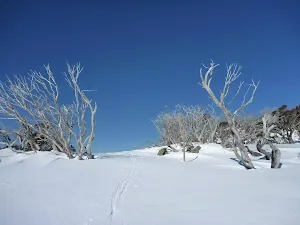
Covered in snow part of the year

Covered in snow part of the year
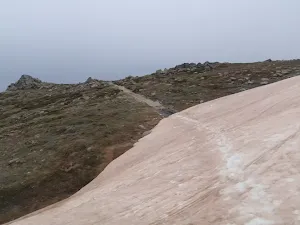
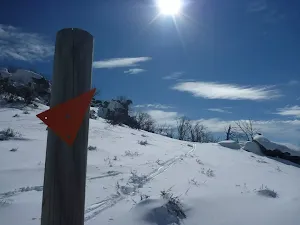
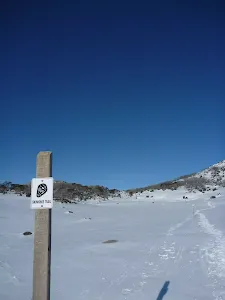
This walk leads through an extreme alpine environment and all walkers must be well prepared. During summer, be prepared for both very hot and cold weather, high winds, rain, snow, extreme UV levels and some sections of snow or ice on the ground. Before starting this walk, check advice with Snowy Region Visitor Information Centre (02) 6450 5600, the weather forecast and the snow conditions then change your plans as needed. These notes, grades and walking times have been written for use in the summer months only. Between May and the end of October, this walk is likely to be covered in snow/ice, visitors should be carrying and be prepared to use snowshoes or cross country skis. When there is a chance of significant snow on the ground, visitors will need particularly strong navigation and snowcraft skills - tracks and signage may not be visible. For most visitors, it is best to consider this walk closed during the colder months.

Guthega

Guthega
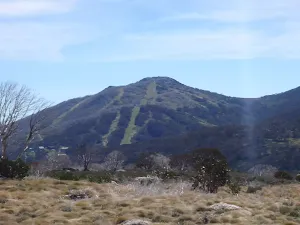
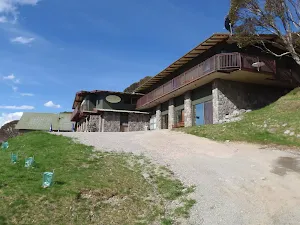
Guthega is a relatively small township, north of Perisher, and comprises mostly of hotel and lodge-style buildings. The most popular service in town is the Guthega Alpine Inn, open year round. The town is remote and access is by an all-weather dirt road. There are great views over the main range and the Guthega Pondage (part of the Snowy River Scheme). Guthega offers a great place to ski in winter, and to holiday in summer. In summer, there is plenty of walking, mountain biking, fishing and relaxing to be done. Walkers please note - there is no public water supply in the township, please fill water bottle before coming (or be willing treat and use the creek water).

Guthega Alpine Inn

Guthega Alpine Inn
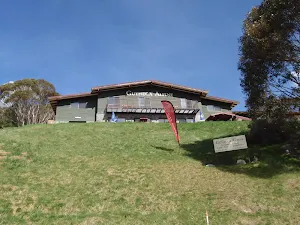
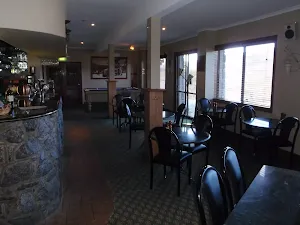
Guthega Alpine Inn is on Guthega Road, about 500 metres past the base of the chairlift and 'Guthega Centre'. The hotel provides a year-round service including accommodation and meals. The hosts are friendly and the hotel provides a great base for walkers and other holiday makers. Please phone and book ahead for meals and accommodation. Phone 02 6457 5383 More info.

(0km) Car park below Guthega Alpine Inn → Int. of Guthega road servicetrail and Flying fox track

distance 480 m time 10 mins climb 6m descent -34m Moderate track
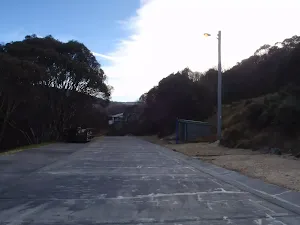
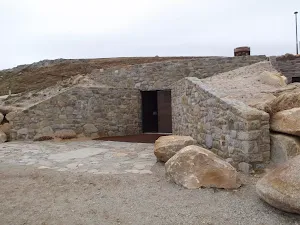
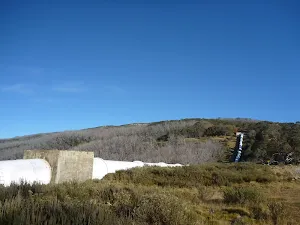
From the car park (just below Guthega Alpine Inn, on Guthega Rd, 500m past the Guthega Centre), the walk follows the concrete road down the hill, keeping the main valley to the left. The road passes a small stone building and light post, just before coming to an intersection with another road heading off to the left, below the building named 'Toibunga'.
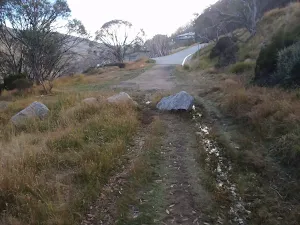
Turn sharp left: From the intersection, the walk follows the concrete road down the hill towards the dam. After about 100m, the track veers right at another intersection, following the lower track. The concrete track turns to the right, but this walk continues straight, onto the wide dirt management trail (between the small boulders). Soon the trail bends right and comes to an intersection with a bush track.

(0km) Int. of Guthega road servicetrail and Flying fox track → Flying Fox

distance 330 m time 9 mins climb 15m descent -44m Moderate track
Turn left: From the intersection, the walk heads between the boulders and is fairly flat initially, then, near a snow gum, the track steps down steeply and then winds down the hill to a 'T' intersection above Blue Cow Creek. (There is broken glass along this section of track, left over from Snowy River Scheme Camps).
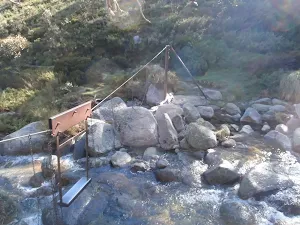
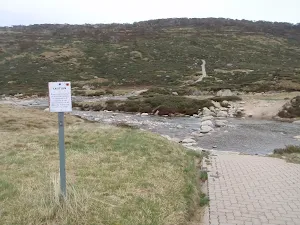
Veer left: From the intersection, the walk initially steps over a small, eroded gap in the track[1] and then heads upstream alongside Blue Cow Creek, keeping the creek to your right. Before long, the track comes closer to the creek, and reaches a rocky crossing with a bridge[2] and a flying fox[3] over the creek.

Flying Fox

Flying Fox
This metal flying fox was put in place to provide a safer option for crossing Blue Cow Creek when the water rises over the rocks. There are many flying foxes in the area to help people cross creeks, especially useful during snow melt when water is cold, deep and fast-moving. In 2010, a metal bridge was installed over this creek, parallel to the flying fox, and the bridge is now the safest way to cross.

(1km) Blue Cow Creek crossing → Illawong Lodge

distance 2.2 km time 50 mins climb 129m descent -87m Moderate track
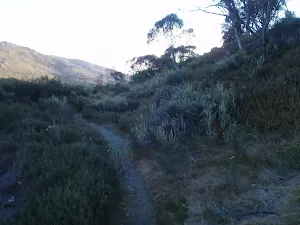
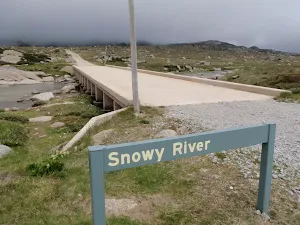
Turn right: From the intersection, the walk crosses the creek on the bridge[4] next to the metal flying fox[5]. The walk then follows the bush track on the other side as it climbs to the top of the ridge. From the top of the hill, the track then winds down towards the Snowy River then turns left and generally follows it upstream. Soon the walk crosses a small creek and continues up the other side, undulating through the valley, crossing several more small creeks. The track winds left, away from the Snowy River, to climb the short hill to Illawong Lodge.

Illawong Lodge

Illawong Lodge
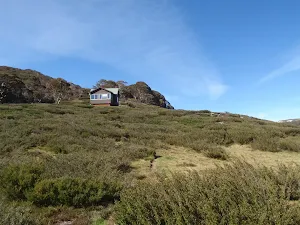
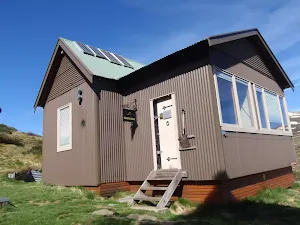
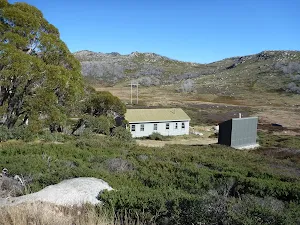
In 1956, the year after the Guthega Dam was first filled, the Kosciuszko State Park Trust gave permission for the conversion of the then-dilapidated hut into the present simple lodge. The lodge is maintained by members of Illawong Ski Tourers and friends. The nearby suspension bridge over the Snowy River and the flying fox over Farm Creek were built by members of Illawong. NPWS now maintains the suspension bridge and a new bridge over Farm Creek which has replaced the flying fox. The lodge can be reserved by members of the general public - see illawong.asn.au. There is also a small emergency shelter in the base of the hut, on the western wall, with enough room for a few people to see out a blizzard, with some water, blankets and other emergency supplies. More info.

(3km) Illawong Lodge → Suspension bridge

distance 160 m time 4 mins climb 0m descent -28m Moderate track
Turn right: From the west side of Illawong Lodge (where the emergency shelter is located), the walk heads down towards the creek following the bush track. The track winds through scrub, passing through a grass clearing along the way. The walk soon comes to a cable suspension bridge.

Suspension Bridge

Suspension Bridge
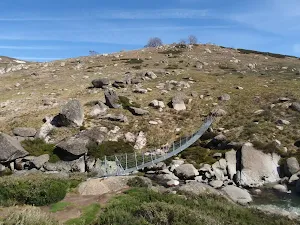
Constructed and maintained by Illawong Ski Tourers, and only a stone's throw from Illawong Lodge, this cable suspension bridge provides a safer way to cross the upper Snowy River. This provides the main access between Guthega and the Main Range. The bridge also provides great views of the valley.

(3km) Suspension bridge → Pounds Creek flats

distance 2.6 km time 1 hr 13 mins climb 342m descent 0m Experienced only
Continue straight: From the suspension bridge, this walk crosses the Snowy River to the west bank and climbs the hill, tending to the left of the top of the hill, and continuing up through the thick scrub. This section of the walk their is not track please fan out and minimse your impact. The walk winds up the ridge line through some more shallow scrub, passing through a thin tree line. The walk continues around to the left side of the ridge, where it gets much steeper, staying high out of the gully (which is to your left). The walk continues to the top of the ridge where it is much rockier, next to the large flats near the headwaters for Pounds Creek.

Pounds Creek Flats

Pounds Creek Flats
Located in the far upper reaches of Pounds Creek, this large flat area on the side of the ridge makes a great place to camp. The plateau forms a shallow hanging swamp in the few months after winter, when the snow melts and pools in the area. This campsite is flat and sheltered from the wind by the mountain. Water supply from the creek is unreliable.

End of day 1

This is the planned overnight stay for the end of day 1, happy camping.

(6km) Pounds Creek flats → Twynam saddle

distance 1.1 km time 29 mins climb 131m descent 0m Experienced only
Veer left: From the flats, this walk heads south-west, following the ridge line that runs up the steep hill. The walk winds up and around the left side of the flats towards Little Twynam, bending around to the right as it approaches the top, then climbing up into the saddle between Little Twynam and Mt Twynam.

(7km) Twynam saddle → Int of Blue Lake track and Little Twynam route

distance 1.7 km time 42 mins climb 40m descent -249m Experienced only
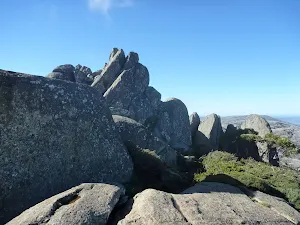
Turn left : From the saddle, the walk heads south-east, up the hill and soon goes through a wide grassy pass between the two large rock outcrops to reach the top of Little Twynam.
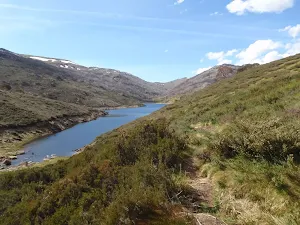
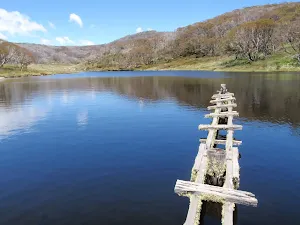
Continue straight: From the top of Little Twynam, the walk follows the ridge running south. The walk heads down the ridgeline, keeping Blue Lake to the right, and tends to the left as Hedley Tarn comes into view. The walk then winds down along the ridgeline, keeping the tarn to the right. After a short distance, the ridge and the hill to the right flattens out substantially and the walk turns down the hill, arcing around towards the southern end of Blue Lake. The walk then crosses Blue Lake Creek, just south of Blue Lake, and almost immediately reaches the intersection of the Hedley Tarn and Blue Lake tracks.

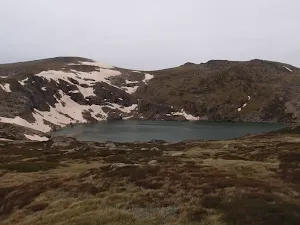
Blue Lake

Blue Lake
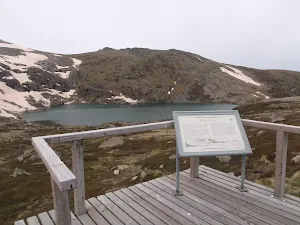
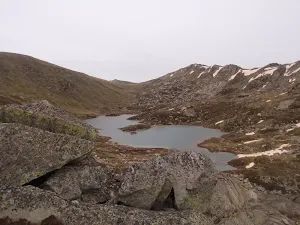
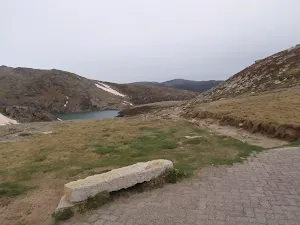
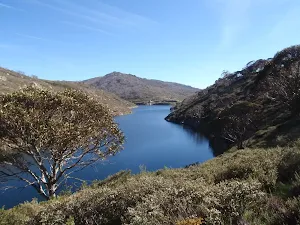
Blue Lake is the best example of a glacial lake in the alpine area. At 28m deep, this lake was formed when glaciers, flowing from the Great Dividing Range, converged and carved out a basin in the rock. This is visible in the cliffs behind the lake, where the glaciers have plucked out blocks of stone and carried them away. There is also a stream that flows from Blue lake, feeding Hedley Tarn just to the south.

(9km) Int of Blue Lake track and Little Twynam route → Int of Main Range and Blue Lake Lookout tracks

distance 1.2 km time 25 mins climb 123m descent -9m Hard track
Veer right: From the intersection, this walk follows the bush track, winding north-west along the trail, following the Blue Lake Creek upstream as it climbs up over the foot of a spur to the south-eastern corner of the Blue Lake.
Veer left: From the intersection, this walk follows the bush track winding west, up over the foot of a spur and continuing up and around the left-hand side of Blue Lake, steadily climbing up the ridge until coming to a platform with an information sign and a great view of Blue Lake about halfway up.
Continue straight: From the platform, the track heads west, uphill[8] away from Blue Lake[9]. The rocky track climbs up around the side of the hill, coming to a paved area[10] with an information sign, stone seat and an intersection with the Main Range track[11].

(10km) Int of Main Range and Blue Lake Lookout tracks → Carruthers Peak

distance 1.7 km time 35 mins climb 159m descent -9m Hard track
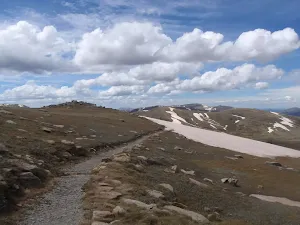
Veer right: From the intersection, this walk heads west, uphill[12] away from Blue Lake[13]. The walk initially heads along a short section of paved path before continuing along the wide gravel track[14]. The track winds gently uphill for a while, keeping the wide valley to your left. The walk comes to a saddle and a three-way intersection, marked with a 'Main Range Track' signpost[15].
Continue straight: From the intersection, this walk follows the 'Main Range Track' sign[16] across the saddle then uphill along the clear track. The track winds up along the ridge and in time comes to a rocky clearing on the eastern side of Carruthers Peak[17] (where a short detour will reveal views down to Club Lake). Here the walk bends right and follows the clear track as it winds up the hill[18] to the views at the top of Carruthers Peak[19].

Carruthers Peak

Carruthers Peak
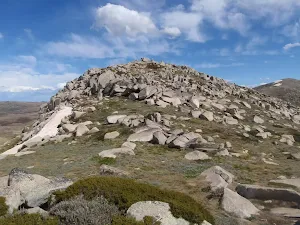
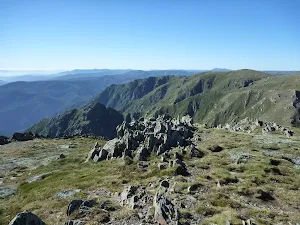
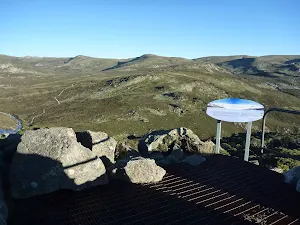
Carruthers Peak is a prominent mountain that is found along the Main Range track, from which you can see great views down over Club Lake and out across the valley to Charlotte Pass. Carruthers Peak was named after the NSW Minister for Lands and Premier, Joseph Carruthers. This name was given in 1991 by Richard Helms, who had previously named it Crummer.

(12km) Carruthers Peak → Int of northern Lake Albina and Main Range tracks

distance 2 km time 41 mins climb 25m descent -102m Hard track
Continue straight: From the top of Carruthers Peak, this walk follows the clear track west as it winds down the ridge[20]. After about 50m, the track passes an 'I30' survey marker[21] (more good views) where the track bends left and follows the stone path and steps down the hill[22]. At the end of the stone path, the track bends left and heads down the hill[23], over a few lengths of metal grate[24] and comes to a saddle with good views down to Club Lake[25] (on your left). The walk then continues across the saddle, following the clear track to soon pass the 'Rarest Alpine Plant Community' information sign[26]. Heading around the side of the hill (keeping the valley to your right), the walk then comes to another rocky saddle[27]. About 320m beyond this saddle, this track leads to a very faint intersection where the ridge[28] (that leads to the northern end of Albina Lake) on the right meets the main track.

(14km) Int of northern Lake Albina and Main Range tracks → Int of southern Lake Albina and Main Range tracks

distance 1.7 km time 37 mins climb 63m descent -108m Hard track
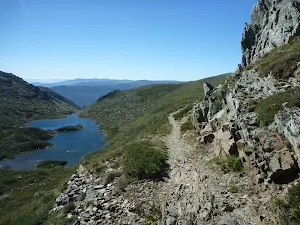
Continue straight: From the intersection, the walk follows the gravel Main Range track south, keeping the valley and Albina Lake to your right. The track heads downhill[29] and then winds around beside a rocky saddle (a short side trip to the left over the small rise reveals some views into the valley). This walk continues along the clear track as it traverses fairly gently around the side of the very steep hill. In a few places, the track has been cut into the rock[30] and provides great views down into the Albina Lake - take care not to slip. The walk continues to another large saddle and just as the track starts to dip down past the saddle, the track comes to a faint intersection with an old management trail[31] (leading to Lake Albina, on your right).

(15km) Int of southern Lake Albina and Main Range tracks → Int of Main Range and Muellers Peak track

distance 520 m time 11 mins climb 17m descent -25m Hard track
Continue straight: From the intersection, the walk follows the rock-paved Main Range track south[32]. The track steadily winds around the side of the hill (keeping the large valley to your left). After heading between a rocky outcrop[33], the track becomes gravel[34] and starts to head over the ridge before gently winding down the hill. Just before flattening out on the large saddle, the track comes to a faint intersection (with the Muellers Peak and Mt Townsend tracks on your right) marked with a rock cairn[35] (on your right).

(16km) Int of Main Range and Muellers Peak track → Muellers Peak

distance 790 m time 23 mins climb 111m descent -4m Experienced only
Turn sharp right: From the intersection, the walk leaves the main path and heads north, off track, following the top of the ridge line[36]. The walk climbs moderately steeply up the grassy hill. Near the top the walk comes to a rocky outcrop[37] and the top of Muellers peak[38].

(17km) Muellers Peak → Int of Mt Townsend and northern Lake Albina track

distance 770 m time 18 mins climb 31m descent -59m Experienced only
Continue straight: From Muellers peak[39], this walk heads north, down the rocky ridge[40]. The walk continues along the ridgeline working a way around the many boulders[41] then around another smaller peak to come to a saddle and minor track intersection (with a pad that leads down to Lake Albina).

(17km) Int of Mt Townsend and northern Lake Albina track → Townsend plateau

distance 720 m time 18 mins climb 73m descent 0m Experienced only
Veer left: From the saddle, this walk heads north-west up the ridge line[42], keeping Lake Albina on your right (as it soon goes out of view) to climb up the hill. After a short time the walk finds a well worm foot pad[43] which leads up between a few rocky outcrops[44] to the large flat saddle[45] between Mt Townsend and Alice Rawson Peak.

Mt Townsend plateau

Mt Townsend plateau
This bush campsite is in the saddle between Mt Townsend and Alice Rawson Peak. The large, reasonably flat grassy area with a scattering of boulders has no facilities or water supply. Camping is not permitted in areas that drain into the glacial lakes, so only camp and toilet on the north side of the saddle (this limits the amount of nutrients ending up in Lake Albina). There is some shelter from south-westerly winds, but the campsite is exposed to the elements. An alternate campsite at Wilkensons Creek to the south may provide more shelter.

(18km) Townsend plateau → Mt Townsend peak

distance 210 m time 7 mins climb 41m descent 0m Experienced only
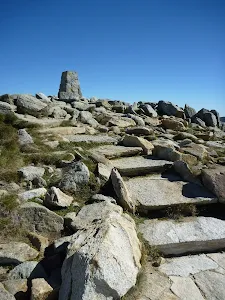
Turn left: From the saddle/plateau, this walk heads west, following the well worn foot pad towards the top of Mt Townsend[46]. The pad leads around to the north eastern side of the peak, over a few boulders to find remains of an old building[47] and a tall rocky outcrop[48]. Here the walk scrambles up the rocks to find a concrete pillar[49] and great views[50] at the peak of Mt Townsend. At the end of this side trip, retrace your steps back to the main walk then Turn right.

Mt Townsend

Mt Townsend
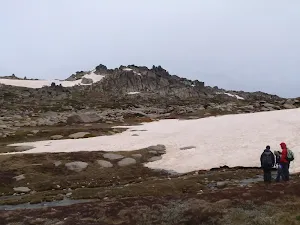
Mt Townsend is the second highest peak on the mainland of Australia and arguably the more impressive out of it and Kosciuszko. This point of view started the tradition of walkers climbing to the peak, putting a rock they'd find at the bottom in their pack and adding it to the top, in an attempt to make it the highest peak instead of Kosciuszko. A little known fact is that Mt Townsend was once called Mt Kosciuszko when it was originally thought that it was the highest peak, but when various measurements showed that the now named Kosciuszko was slightly higher, the NSW Lands department decided it would be easier to swap the names around instead of re-educating the public.

End of day 2

This is the planned overnight stay for the end of day 2, happy camping.

(18km) Townsend plateau → Int of Main Range and Muellers Peak track

distance 2.3 km time 56 mins climb 45m descent -196m Experienced only
Turn around: From the saddle/plateau[51] between Mt Townsend and Alice Rawson Peak, this walk heads south-east following the well worn foot-pad. The pad soon crosses a small creek[52] and leads down the hill, tending right along the side of the ridge. The pad leads just below the saddle north of Muellers Peak[53], then continues to head fairly gently downhill around the side of Muellers Peak. Keeping Wilkinsons Creek valley below to your right[54], this walk heads around the side of the hill, crossing a few gullies before gently climbing up to the northern end of a large saddle where this walk comes to the gravel Main Range Track[55].

(20km) Int of Main Range and Muellers Peak track → Int of Main Range track and Kosciuszko walk

distance 1.6 km time 42 mins climb 162m descent -9m Hard track
Veer right: From the intersection, this walk heads south along the main track to the low point in the saddle[56] (where there is a faint intersection with a pad leading down to Wilkinsons Creek on your right).
Continue straight: From the intersection[57], this walk heads south along the clear track, climbing up out of the saddle and along the side of the hill, keeping the valley to your left. The walk heads up many stone steps[58] for about 600m, then flattens out for a little while[59] before coming to a clear and signposted three-way intersection[60]. (Here, the track on the right leads up to the summit of Mt Kosciuszko.)

(22km) Int of Main Range track and Kosciuszko path → Mt Kosciuszko

distance 970 m time 23 mins climb 76m descent -15m Hard track
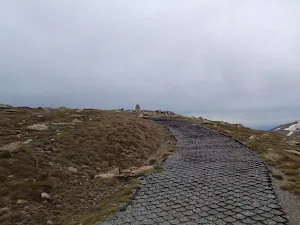
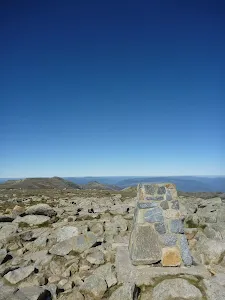
Turn sharp right: From the intersection, this walk follows the 'Mt Kosciuszko' sign[61] uphill along the upper track. This track winds steadily up and around the peak of the mountain, passing a stone-paved[62] section of track, and also a metal grate[63] before climbing a few steps[64] to the cairn at the peak of Mt Kosciuszko[65].

Mt Kosciuszko

Mt Kosciuszko
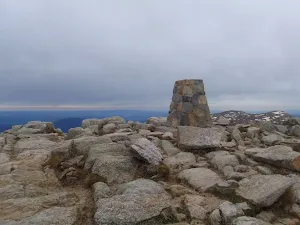
Mt Kosciuszko is the highest peak on the Australian continent, at 2228m above sea level. It was named by the Polish explorer Count Paul Edmund Strzelecki and named in honour of the Polish national hero General Tadeusz Kościuszko. Now a popular tourist attraction, thousands of people walk up to the summit each year. On a clear day, the 360-degree views from the summit across the roof of Australia are fantastic. There are higher mountains elsewhere on Australian territory. 'The highest mountains in Australian Antarctic Territory are Mt McClintock (3490 meters) and Mt Menzies (3355 meters).' .

(23km) Mt Kosciuszko → Rawson Pass

distance 1.6 km time 39 mins climb 23m descent -127m Hard track
Turn around: From the cairn at the peak of Mt Kosciuszko[67], this walk heads down the steps[68] and past the information sign[69]. The walk heads gently downhill along the gravel track[70] then over a metal grate[71] and a stone path[72], where the gravel path then leads[73] the rest of the way around the side of the peak to come to the signposted intersection with the 'Main Range Track'[74][75].
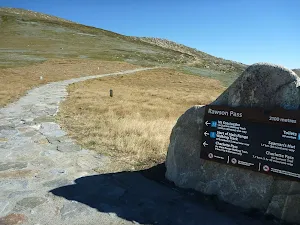
Veer right: From the intersection, this walk follows the gravel track towards 'Rawson Pass'[76] gently downhill, keeping the main valley to your left. The track almost immediately passes an 'Alpine Walks' information sign and map[77] as it continues south. After about 500m, the track becomes a stone path[78] that leads a little further to the clearly signposted three-way intersection at 'Rawson Pass'[79].

Rawson Pass

Rawson Pass
Rawson Pass is where the old Kosciuszko Road, from Charlotte Pass, meets the metal walkway from Thredbo. It is home to highest public toilet in Australia, this recently-added facility is perfectly positioned for those taking the walk up to the top of Kosciuszko. Rawson Pass is well signposted and 500m south east of Mt Kosciuszko (by straight line). There is also a place for to park mountain bikes for those cycling along the old road from Charlotte Pass.

(25km) Rawson Pass → Seamans Hut

distance 1.6 km time 31 mins climb 15m descent -114m Hard track
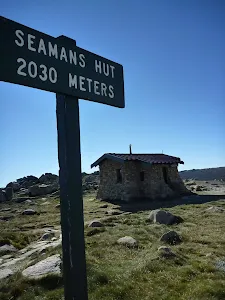
Veer left: From the intersection at Rawson Pass[80], this walk follows the 'Seamans Hut' sign[81] along the stone path. The walk soon passes the bicycle parking area[82] then Australia's highest toilet block[83] (on your right). The walk then continues along the management trail[84] as it winds down along the side of the hill to a gap and the clearly signposted 'Seamans Hut'[85] on your left.

Seamans Hut

Seamans Hut
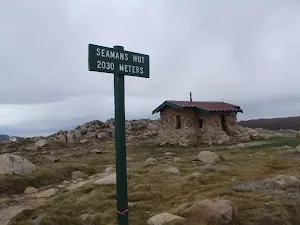
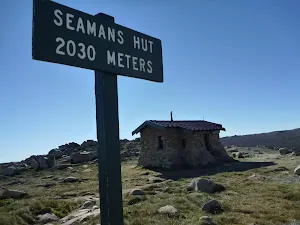
This hut was erected in 1929, after a young skier named Laurie Seaman perished in a blizzard when he was separated from his group. The hut was built using money donated by Seaman's parents, for the use of those who might need emergency shelter in the mountains. It was renovated in 1938 due to fire. Seamans Hut is a 7m x3m granite stone building with a wood stove, although there is little wood in the area. More info.

(26km) Seamans Hut → Foremans Hut ruins

distance 3.9 km time 1 hr 28 mins climb 6m descent -292m Experienced only
Veer left: From 'Seamans Hut', this walk initially heads east, off track, up to the top of the ridge[87], keeping the old road off to the right. From here the route bends left then heads north east down the ridge line. The track winds along the ridge line, down to the past another large rocky outcrop[88] to continue to the a point north west of the confluence of the Snowy River and a large tributary. The heath become dense and taller the further down the ridge which can make progress slow and difficult. Here the walk crosses the tributary[89]. This crossing may become impassable after rain or during snow melt.
Continue straight: From the creek crossing[90], this walk generally heads north east following the Snowy River downstream. The walk winds down through the valley until as it narrows to a steep gully[91] where this walk climbs up the side of the hill, around the top of the steep gully. The walk leads through the knee-high dense heath that can really slow progress. After a while, the gully widens out again and this walk heads back down onto the main valley floor, to continue along parallel to the river. After about 2km from the creek crossing, this walk comes to the lone standing brick chimney at the ruins of Foremans Hut[92].

Foremans Hut Ruins

Foremans Hut Ruins
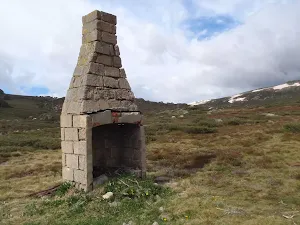
Foremans Hut was built in the 1920's for a Dr Foreman of Wagga Wagga. Most of the hut was demolished in the 1940s, leaving the prominent chimney behind, which has in the past been used by a number of people as a navigation landmark, to save their lives in a blizzard. This is also a nice place to camp for the night as there is a lot of open flat space. Water can be found at the Snowy River to the south or Club Lake Creek just to the north. More info.

End of day 3

This is the planned overnight stay for the end of day 3, happy camping.

(30km) Foremans Hut ruins → Snow river crossing

distance 490 m time 9 mins climb 0m descent -18m Experienced only
Continue straight: From the ruins[93], the walk heads east, keeping the Snowy River to the right (and Club Lake Creek a bit further to your left). The walk continues for about 500m to pass an old fence line[94] to the clear intersection with the wide Main Range track (between the Snowy River and Club Lake Creek crossings).

(31km) Snowy River crossing → Int of Main Range and Blue Lake Lookout tracks

distance 3.2 km time 1 hr 7 mins climb 306m descent -33m Hard track
Turn left : From between the two creeks, this walk heads north along the wide track to cross Club Lake Creek using the stepping stones. (The creek may not be safe to cross when water covers the stepping stones[95]). The walk then follows the wide, paved track fairly steeply up the hill. After a short time, the track becomes gravel and continues up the hill for about 400m further before passing a 'Mountains of Soil' information sign[96], where the track soon becomes less steep. After about 1.5km, the track passes a 'Created by glaciers' information sign[97] and reveals some views down to Hedley Tarn[98] (on your right). The track continues up the hill and between the granite boulders[99] to then head down the other side of the ridge[100]. The walk leads down to rock-hop across Carruthers Creek[101], then follows the wide, paved path up the hill, passing the 'Remnants of an ancient sea' information sign[102] and coming to a paved area[103], with a view to Blue Lake[104] and some information signs marking a three-way intersection.

(34km) Int of Main Range and Blue Lake Lookout tracks → Int of Main Range and Mt Twynam tracks

distance 880 m time 17 mins climb 60m descent -7m Hard track
Turn left: From the intersection, this walk heads west, uphill[105] away from Blue Lake[106]. The walk initially heads along a short section of paved path before continuing along the wide gravel track[107]. The track winds gently uphill for a while, keeping the wide valley to your left. The walk comes to a saddle and a three-way intersection, marked with a 'Main Range Track' signpost[108].

(35km) Int of Main Range and Mt Twynam tracks → Int of Mt Twynam and Blue Lake view tracks

distance 950 m time 20 mins climb 60m descent -2m Experienced only
Turn right: From the intersection, this walk heads around behind the Main Range track signpost and follows the faint 4WD trail north-east, winding up the grassy hill onto the ridge line. The walk follows the ridge line as it winds around the left-hand side of Blue Lake, steadily climbing up to the left of the first knoll. There is a great view of Blue Lake from the hill on the right-hand side of the trail.

(36km) Int of Mt Twynam and Blue Lake view tracks → Blue Lake view

distance 90 m time 2 mins climb 1m descent -2m Experienced only
Turn right: From the intersection, the walk heads south east, towards the lake and soon reaches the top of the gentle hill. The view from here spans across the lake and down through to the gully to the northern end of Headley Tarn. At the end of this side trip, retrace your steps back to the main walk then Turn right.

(36km) Int of Mt Twynam and Blue Lake view tracks → Mt Twynam

distance 1.9 km time 41 mins climb 106m descent -24m Experienced only
Continue straight: From the first rise, this walk heads north along the ridge line, keeping Blue Lake to your right as the walk steadily climbs up around to the base of Mt Twynam. At this point, the old management trail ends and the walk continues south-east, climbing up through the rock outcrops to the old trig station at the top of the mountain.

Mt Twynam

Mt Twynam
Mt Twynam is the largest peak on the ridgeline that winds around behind Blue Lake. It was once the location of a trig station, which was used for navigation until it was taken down. The metal frame, which was the lower half of the station, still sits on the peak today.

(38km) Mt Twynam → Blue Cow Creek crossing

distance 6.6 km time 2 hrs 49 mins climb 115m descent -699m Experienced only
Continue straight: From the top of the mountain, this walk heads south-east, down towards Little Twynam. The walk winds down through small rocky outcrops and down the steep rocky hill into the saddle between Mt Twynam and Little Twynam.
Turn left: From the saddle, this walk heads east up and around to the left side of Little Twynam. The walk turns left and winds down the ridge, heading towards the ski runs at Guthega to the far east. Following the rocky ridge line, this walk heads down and around the right-hand side of the large flats near the headwaters of Pounds Creek, until the ridge flattens out next to the flats.
Veer right: From the Pounds Creek flats, this walk heads east down the ridge, heading towards the distant Illawong Lodge. The track winds to the east, down the right-hand side of the ridge while staying high out of the gully (which is to your right). The walk winds back onto the ridge line as it flattens out a little. Continuing down through a small tree line, the track heads through thick scrub, following the ridge to the bottom, where the walk comes to the Snowy River crossing at the cable suspension bridge.
Continue straight: From the cable suspension bridge, the walk heads east up the steep hill through the scrub, to Illawong Lodge (the hut at the top).
Turn left: From Illawong Lodge, the walk heads down the hill, on the north side of the building. The track winds and undulates through the valley, heading downstream. The walk crosses several small creeks and generally follows the Snowy River downstream. After quite some time, the track turns right and begins to wind along the side of the ridge, steadily climbing to the top. The track continues fairly steeply down the other side of the ridge, towards Blue Cow Creek. The walk then crosses Blue Cow Creek on the bridge[109] next to the metal flying fox[110].

(44km) Flying Fox → Int. of Guthega road servicetrail and Flying fox track

distance 330 m time 9 mins climb 44m descent -15m Moderate track
Turn left: From the bridge and flying fox, the walk heads downstream, keeping Blue Cow Creek to your left[111]. The creek soon starts to widen as it approaches the dam, and the track moves gently up the hill, but still runs parallel with the creek. Soon, the walk steps across an eroded section of track, then comes to a 'Y' intersection with another track (which heads up the hill to the right).
Veer right: From the intersection, the walk heads up the hill away from the creek. The track winds up through the heath towards the snow gums. There are a couple of short, steep sections in the track, just near the top of the hill. Near the top, the track passes between some boulders and comes to a 'T' intersection with a management trail, and there is a view of part of the Guthega village, up to the right. (There is broken glass along this section of track, left over from Snowy River Scheme Camps).

(45km) Int. of Guthega road servicetrail and Flying fox track → Car park below Guthega Alpine Inn

distance 480 m time 10 mins climb 34m descent -6m Moderate track
Turn right: From the intersection, the walk follows the wide management trail that heads gently up the hill and then continues up along the concrete road towards the buildings. After passing the pump house on the left, the walk then comes to another concrete road. Here, the walk veers left and continues up the hill to Guthega Rd (just below a building called 'Toibunga').
Turn sharp right: From the intersection, just below the building named 'Toibunga', this walk follows Guthega Rd up the hill. The road soon passes a stone building and street light. There are great views over the valley to the right as the road climbs the hill. Soon, the road widens into a car park - The Guthega Alpine Inn is up the hill to the left.

Maps for the Main Range Circuit from Guthega walk

You can download the PDF for this walk to print a map.
These maps below cover the walk and the wider area around the walk, they are worth carrying for safety reasons.

Perisher Valley1:25 000 Map Series85252S PERISHER VALLEYNSW-85252S
Chimneys Ridge1:25 000 Map Series85241N CHIMNEYS RIDGENSW-85241N
Kosciuszko1:100 000 Map Series8525 KOSCIUSZKO8525
Jacobs River1:100 000 Map Series8524 JACOBS RIVER8524

Cross sectional view of the Main Range Circuit from Guthega bushwalking track
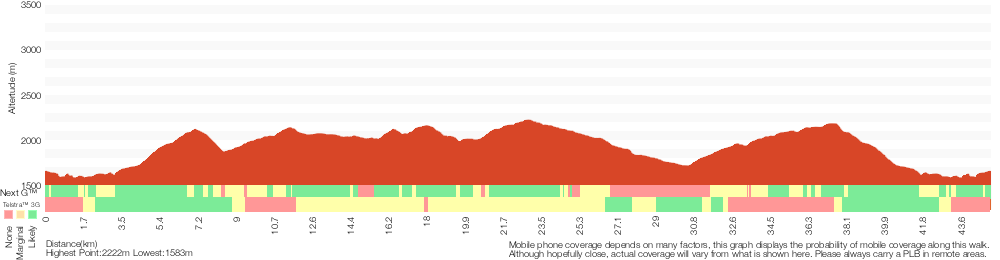
Terrain profile for Main Range Circuit from Guthega

Analysis and summary of the altitude variation on the Main Range Circuit from Guthega
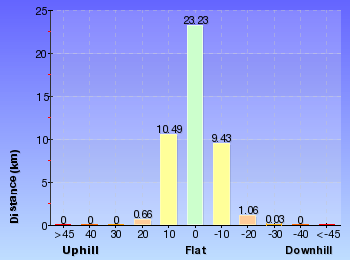
Altitude analysis for Main Range Circuit from Guthega

Overview of this walks grade – based on the AS 2156.1 – 2001

Under this standard, a walk is graded based on the most difficult section of the walk.

Length45 km
Time4 Days
.


Grade 5/6


Experienced only
AS 2156.1GradientVery steep (4/6)
Quality of trackRough unclear track (5/6)
SignsNo directional signs (5/6)
Experience RequiredHigh level of bushwalking experience recommended (5/6)
WeatherForecast, unforecast storms and severe weather likely to have an impact on your navigation and safety (5/6)
InfrastructureNo facilities provided (5/6)

Some more details of this walks Grading

Here is a bit more details explaining grading looking at sections of the walk

Gradient

31km of this walk has short steep hills and another 9km has gentle hills with occasional steps. Whilst another 3.1km is very steep and the remaining 2.4km is flat with no steps.

Quality of track

14km of this walk follows a rough unclear track and another 14km follows a formed track, with some branches and other obstacles. Whilst another 14km follows a clear and well formed track or trail and a 2.2km section follows a rough track, where fallen trees and other obstacles are likely. The remaining 960m follows a smooth and hardened path.

Signs

16km of this walk is clearly signposted and another 15km Has no directional signs. Whilst another 9km has directional signs at most intersection and the remaining 6km has minimal directional signs.

Experience Required

18km of this walk requires some bushwalking experience and another 13km requires a leader with a high level of bushwalking experience. Whilst another 8km requires a leader a with moderate level of bushwalking experience and the remaining 5km requires no previous bushwalking experience.

weather

30km of this walk is affected by forecast, unforecast storms and severe weather events that may impact on navigation and safety and another 8km forecast, unforecast storms and severe weather likely to have an impact on your navigation and safety. Whilst another 6km is affected by storms that may impact your navigation and safety and the remaining 1.4km is not usually affected by severe weather events (that would unexpectedly impact safety and navigation).

Infrastructure

21km of this walk has limited facilities (such as not all cliffs fenced) and another 12km is close to useful facilities (such as fenced cliffs and seats). Whilst another 6km has no facilities provided and the remaining 6km has limited facilities (such as cliffs not fenced, significant creeks not bridged).

Similar walks

A list of walks that share part of the track with the Main Range Circuit from Guthega walk.

Other Nearby walks

A list of walks that start near the Main Range Circuit from Guthega walk.

Plan your trip to and from the walk here

The Main Range Circuit from Guthega walk starts and ends at the Car park below Guthega Alpine Inn (gps: -36.382035, 148.37259)

Weather Forecast

This walk starts in the Snowy Mountains weather district.

Current Alerts

Park Information

Kosciuszko National Park

Comments